



What Is Hydrocolloid?
- Ingredient Guide
Hydrocolloid is the soft, gel-forming material used in many pimple patches. Over a surfaced blemish, it forms a thin, translucent cover with a water-resistant barrier. As the material interacts with moisture, the patch gradually turns opaque.
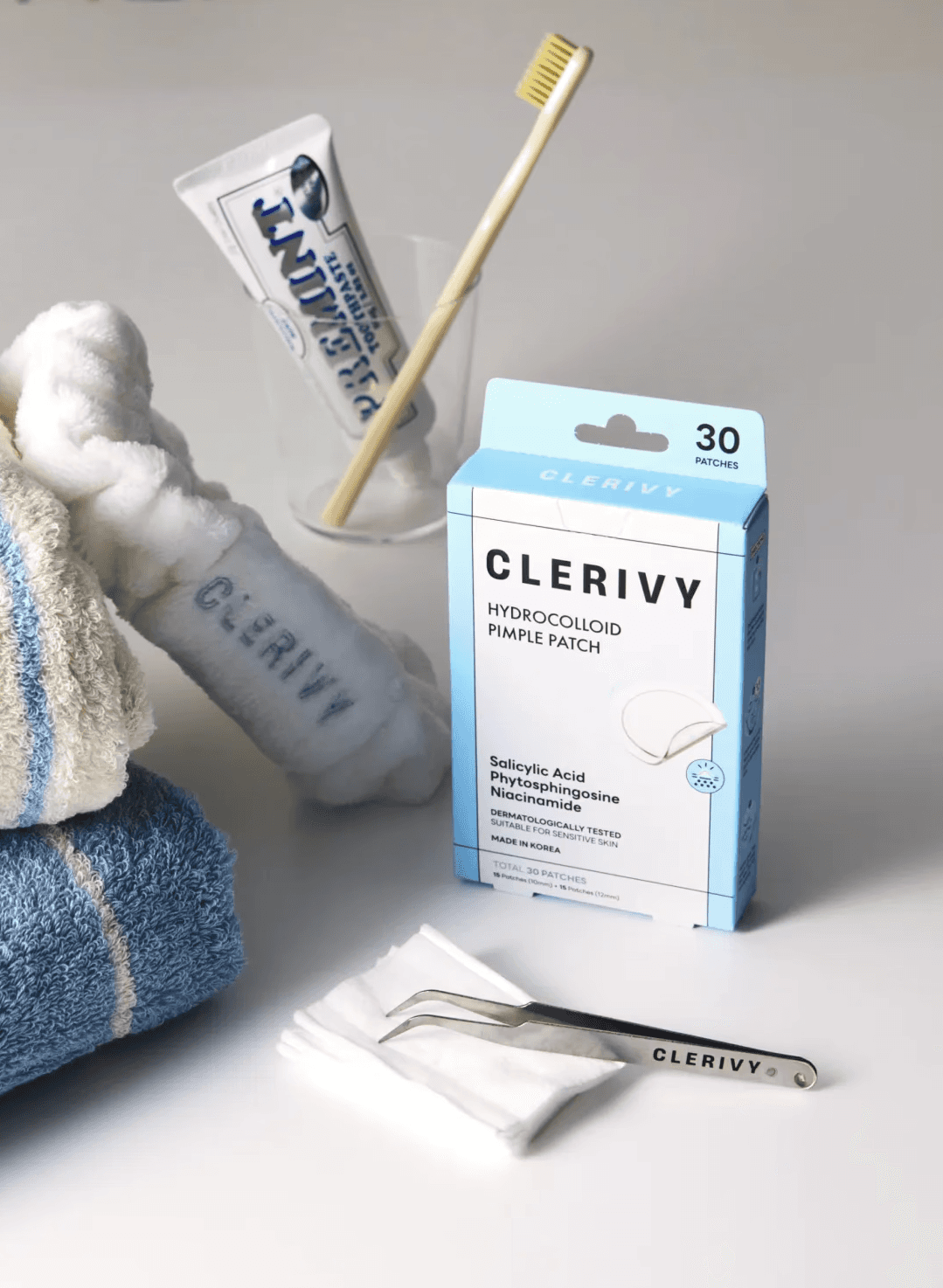
CLERIVY Hydrocolloid Pimple Patch at a Glance
Patch | A smooth, translucent layer with a warm cream tone |
|---|---|
Sizes | 10 mm and 12 mm in every pack |
Wear time | Leave on for 4–8 hours, or until the patch turns opaque. |
Product type | Cosmetic pimple patch |
Where Does Hydrocolloid Come From?
Hydrocolloid was used in wound dressings before it became a familiar skincare material. Its ability to form a soft gel on contact with moisture also lends itself to small patches that cover individual spots. The name describes this gel-forming behavior rather than one specific ingredient.
How Hydrocolloid Patches Work
The patch covers a surfaced blemish with a thin, water-resistant layer. It also helps keep your fingers off the area, making it easier to leave the spot alone.
For more on choosing and using a patch, read How Pimple Patches Work — and Their Limits.
Why Does the Patch Turn Opaque?
Hydrocolloid changes appearance as it interacts with moisture. For the CLERIVY Hydrocolloid Pimple Patch, this is a cue to remove it: leave on for 4–8 hours, or until the patch turns opaque. The color change does not measure how much a blemish has changed.
Learn more about why hydrocolloid patches turn opaque.
Inside the CLERIVY Hydrocolloid Pimple Patch
Polyisobutene and Cellulose Gum form the adhesive and gel-forming base of the patch. Together, they create one smooth layer with no dots or inner ring.
Full ingredient list: Polyisobutene, Cellulose Gum, Salicylic Acid, Phytosphingosine, Allantoin, Panthenol, Niacinamide.
Explore our guides to Salicylic Acid and Phytosphingosine for a closer look at these ingredients.
This product contains less than 0.5% Salicylic Acid for cosmetic purposes only. It is not intended to treat, prevent, or cure acne or any other medical condition.
Two Sizes in Every Pack
Every pack includes equal numbers of 10 mm and 12 mm patches: 15 of each in the 30-count pack, 36 of each in the 72-count pack, and 48 of each in the 96-count pack.
Choosing a Patch for Your Spot
Use the Hydrocolloid Pimple Patch to cover a surfaced blemish on intact skin. Do not apply it to wounded or damaged skin.
For an early bump you can feel before it surfaces, explore the Microdart Spot Patch, which has 16 dissolving microdarts. Our Hydrocolloid vs Microdart guide explains the difference.
Related Reading
Sources
CLERIVY Hydrocolloid Pimple Patch — on-pack FUNCTIONS, DIRECTIONS & INGREDIENTS (2026)
Lanel B. et al., "Swelling of hydrocolloid dressings," Biorheology 34(2) (1997): 139–153, doi:10.1016/S0006-355X(97)00010-3
Seaman S., "Dressing selection in chronic wound management," Journal of the American Podiatric Medical Association 92(1) (2002): 24–33, PMID:11796796
CLERIVY Hydrocolloid Pimple Patch and Microdart Spot Patch are cosmetic products. They are not intended to treat, prevent, or cure acne or any other medical condition.
Last updated: September 6, 2026


