

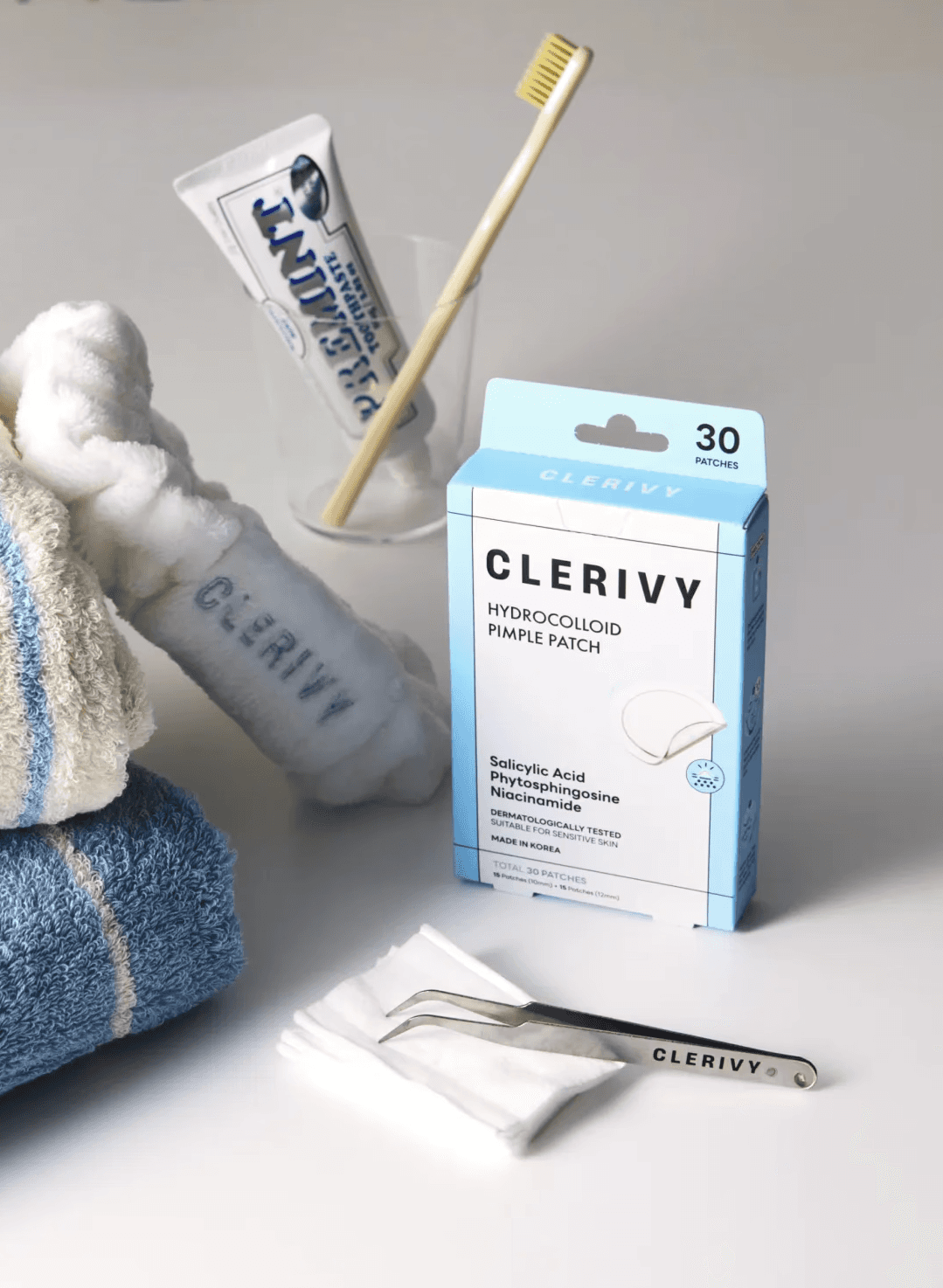


Why Do Hydrocolloid Patches Turn White (Opaque)?
- why-pimple-patches-turn-opaque
Why does a hydrocolloid patch turn white or opaque? Hydrocolloid changes appearance as it interacts with moisture. On CLERIVY patches, the opaque look is the on-pack signal that it may be time to remove the patch, alongside the 4–8 hour wear direction.
Quick Facts | Answer |
|---|---|
What the change looks like | A translucent patch becomes white or opaque during wear |
Why it happens | Hydrocolloid interacts with moisture |
What it signals | It may be time to remove the patch |
Wear direction | 4–8 hours, or until opaque |
What it is not | A measure of skin results |
Why Does a Hydrocolloid Patch Turn White?
Hydrocolloid is a gel-forming material. As it interacts with moisture, the patch changes from translucent to white or opaque. “White” and “opaque” describe the same visible change in this context.
This removal cue applies to the CLERIVY Hydrocolloid Pimple Patch. The Microdart Spot Patch is a different format with separate directions. Compare hydrocolloid and microdart patches by spot stage.
When Should I Remove the Patch?
Leave the Hydrocolloid Pimple Patch on for 4–8 hours, or until it turns opaque. The direction gives you a time cue and an appearance cue; follow whichever comes first.
Apply the patch to a clean, completely dry surfaced spot on healthy, intact skin.
Leave it on for 4–8 hours, or until the patch turns opaque.
Gently peel the patch back along the skin. Do not pull upward.
The patch is water-resistant, not waterproof. CLERIVY does not provide shower or swimming directions for this patch. Do not use it on wounded or damaged skin.
Does an Opaque Patch Mean It Worked?
An opaque patch shows that the material has interacted with moisture and can serve as a removal cue. It is not a score of skin results and does not tell you how the spot will look after removal.
What If the Patch Never Turns Opaque?
Use the time cue. If the patch remains translucent, remove it at the end of the 4–8 hour wear window. Each patch is for single use only.
Related Reading
CLERIVY Hydrocolloid Pimple Patch — sizes, counts, ingredients, and directions
How Pimple Patches Work — hydrocolloid, microdart, water, and limits
How to Use CLERIVY Patches — application and removal
Sources
CLERIVY Hydrocolloid Pimple Patch on-pack directions and caution (2026)
Lanel B. et al., “Swelling of hydrocolloid dressings,” Biorheology 34(2) (1997): 139–153, doi:10.1016/S0006-355X(97)00010-3
Seaman S., “Dressing selection in chronic wound management,” Journal of the American Podiatric Medical Association 92(1) (2002): 24–33, PMID:11796796
CLERIVY Hydrocolloid Pimple Patch and Microdart Spot Patch are cosmetic products. They are not intended to treat, prevent, or cure acne or any other medical condition.
Last updated: August 27, 2026


