

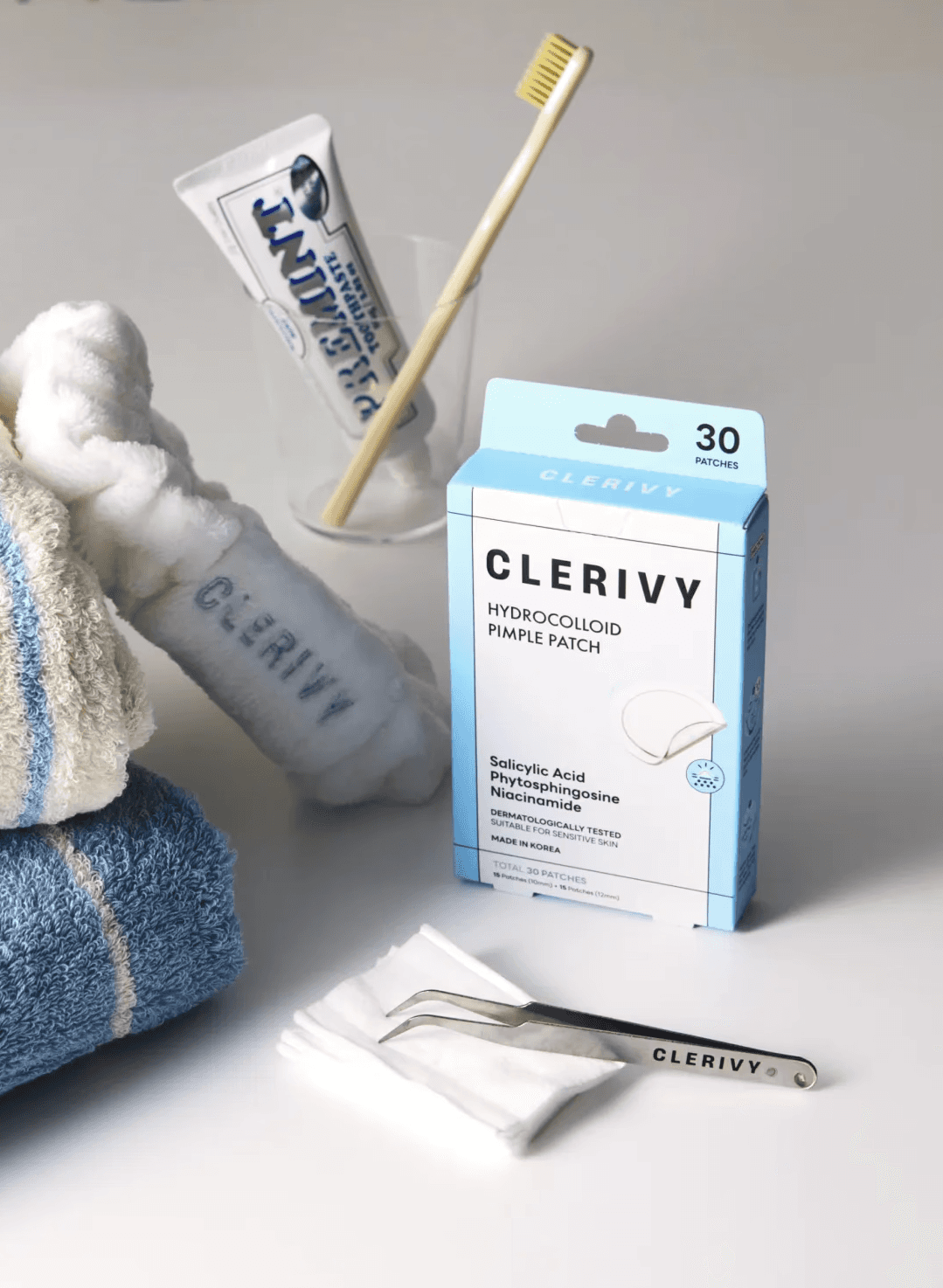


The Testing Behind Our Patches
Explore how Hydrocolloid Pimple Patch and Microdart Spot Patch were tested, with study details and vegan and cruelty-free status for each product.
Cutis Biomedical Research Center in South Korea conducted the six studies below for GUHADA Co., Ltd., the company behind CLERIVY.
Hydrocolloid Pimple Patch
Sensitive Skin Tested
Suitable for Sensitive Skin
23 women with sensitive skin used Hydrocolloid Pimple Patch once daily for one week. Researchers measured facial redness and moisture loss through the skin and monitored skin reactions.
Report: CBRC-E-260610-52 · August 19, 2026
Non-Comedogenic Tested
22 participants with blemish-prone skin used Hydrocolloid Pimple Patch once daily for one week. Researchers assessed the skin visually and measured oil levels and redness.
Report: CBRC-E-260610-53 · August 19, 2026
Across these two one-week studies, no assessed adverse skin reactions were observed.
Primary Skin Irritation Tested
31 adults took part in a single 24-hour patch test of Hydrocolloid Pimple Patch on the upper back. No irritation reactions were observed at the assessments 1 hour and 24 hours after removal. The mean skin reaction score was 0.00 under the study criteria.
Report: CBRC-I-260818-96-01 · August 28, 2026
Microdart Spot Patch
The two one-week studies tested the complete routine: the included Blemish Clearing Pad, followed by Microdart Spot Patch once the skin was dry.
Sensitive Skin Tested
Suitable for Sensitive Skin
23 women with sensitive skin used the Microdart Spot Patch two-step routine once daily for one week. Researchers measured facial redness and moisture loss through the skin and monitored skin reactions.
Report: CBRC-E-260611-54 · August 25, 2026
Non-Comedogenic Tested
21 participants with blemish-prone skin used the Microdart Spot Patch two-step routine once daily for one week. Researchers assessed the skin visually and measured oil levels and redness.
Report: CBRC-E-260611-55 · August 25, 2026
Across these two one-week studies, no assessed adverse skin reactions were observed.
Primary Skin Irritation Tested
In a separate study, 31 adults took part in a single 24-hour patch test of Microdart Spot Patch on the upper back. No irritation reactions were observed at the assessments 1 hour and 24 hours after removal. The mean skin reaction score was 0.00 under the study criteria.
Report: CBRC-I-260818-96-02 · August 28, 2026
Study Methods
The One-Week Studies
Researchers compared skin assessments before and after one week of daily use. Each study followed a single group without a control group and did not assess longer-term use.
Participants in the sensitive-skin studies were selected using a lactic acid stinging test. The non-comedogenic studies excluded people with sensitive or hypersensitive skin.
The 24-Hour Irritation Tests
Each test included 31 adults aged 20–59. Researchers placed the product in an IQ Chamber, secured it to the upper back for 24 hours, and assessed the skin 1 hour and 24 hours after removal. Skin reactions were scored using International Contact Dermatitis Research Group criteria.
These tests excluded people with sensitive or hypersensitive skin. Suitability for sensitive skin was evaluated in the separate one-week studies.
A mean score of 0.00 reflects the skin responses observed under these test conditions. It does not establish that a product is hypoallergenic, and individual skin responses can vary.
Dermatologically Tested
Advanced Science Laboratories, Inc. conducted separate dermatological compatibility tests for Hydrocolloid Pimple Patch and Microdart Spot Patch.
Vegan & Cruelty-Free
Hydrocolloid Pimple Patch
Certified by EVE VEGAN.
Certified cruelty-free, with no animal testing conducted in the development and production of the product.
Microdart Spot Patch
Registered with The Vegan Society.
Certified cruelty-free, with no animal testing conducted in the development and production of the product.
Cosmetic Patches and OTC Acne Patches
Hydrocolloid Pimple Patch and Microdart Spot Patch are cosmetic products. They are not intended to treat, prevent, or cure acne or any other medical condition.
The separate Microdart Acne Patch is an OTC acne drug with 2% salicylic acid and its own Drug Facts. The six studies on this page cover Hydrocolloid Pimple Patch and Microdart Spot Patch.
Reviewed by Yunyoung Park
PB Lab Lead, GUHADA Co., Ltd.
In-house review of the product information, study summaries, and certification details on this page.
Last updated:


